Highlights of Antarctica Expedition Cruise
12-day all-inclusive Antarctica expedition cruise from Ushuaia with round-trip flights from Buenos Aires
One of our most popular expeditions that gives you the ideal Antarctica experience – powerful, purposeful and packed with discovery.
Witness incredible wildlife scenes as we spot seals, penguin colonies and whales against a backdrop of staggering natural beauty.
Join the Expedition Team as they lead you on a journey of learning and adventure.
Breathtaking icescapes
Marvel at colossal glaciers and icebergs on this incredible Antarctica expedition cruise. Experience nature's majesty as we navigate ever-changing icescapes on our hybrid-powered ship. Your Expedition Team will bring you close to your stunning surroundings on ice-cruising and landing activities.
Antarctic wildlife
It's a busy time for the wildlife of Antarctica between November and March. In October and November, penguins court and nest, while December and January are when penguins hatch. February and March offer peak whale watching opportunities.
Key Expedition Details
Itinerary
Your adventure at a glance. Daily highlights, included activities, and optional extras to make it unforgettable.
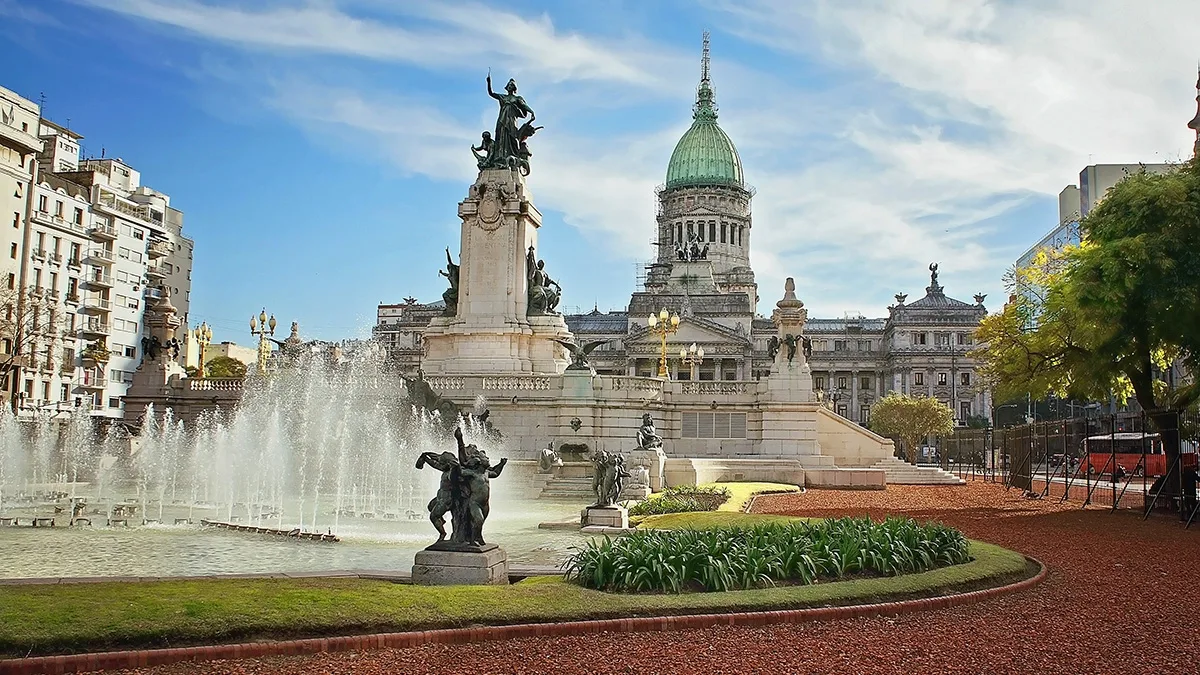
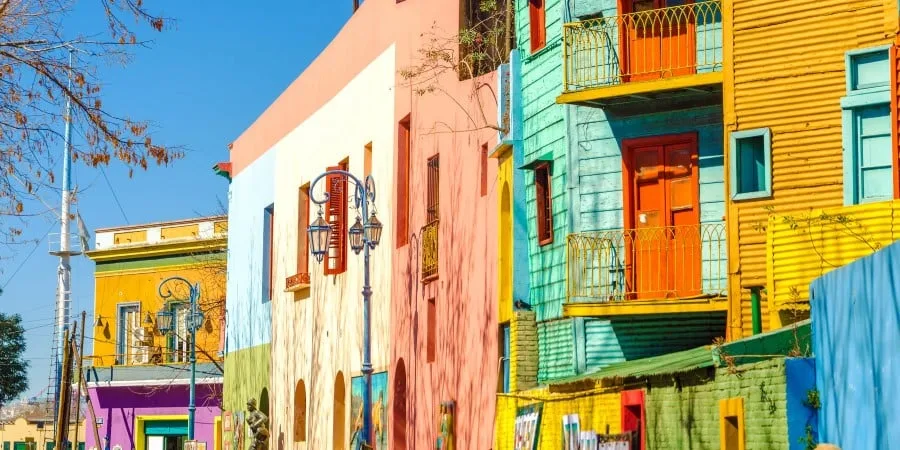
Feel the rhythm of bustling Buenos Aires
Home to a proud and diverse community of porteños, or ‘people of the port’, Buenos Aires is a sensuous fusion of faded European splendour and Latin American panache. An overnight stay here is the ideal way to start your adventure.
There are plenty of places to explore, including many parrillas serving authentic Argentine steak. Or maybe you’d like to practise your dance moves in the famous hometown of the tango.
Why not consider arriving a few days early to see all this vibrant city has to offer.

Setting off from the bottom of the world
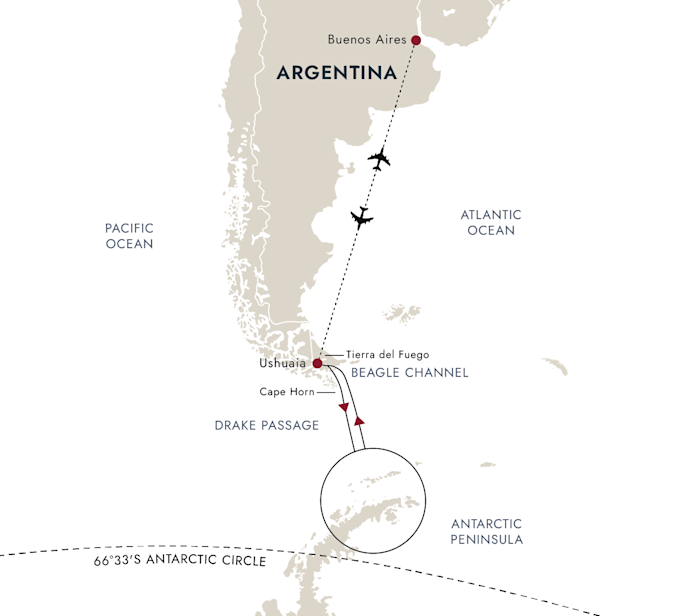
Your adventure begins with an early morning flight to Ushuaia, where you’ll meet our hybrid electric-powered expedition ship, specially designed for sustainable cruising in polar waters.
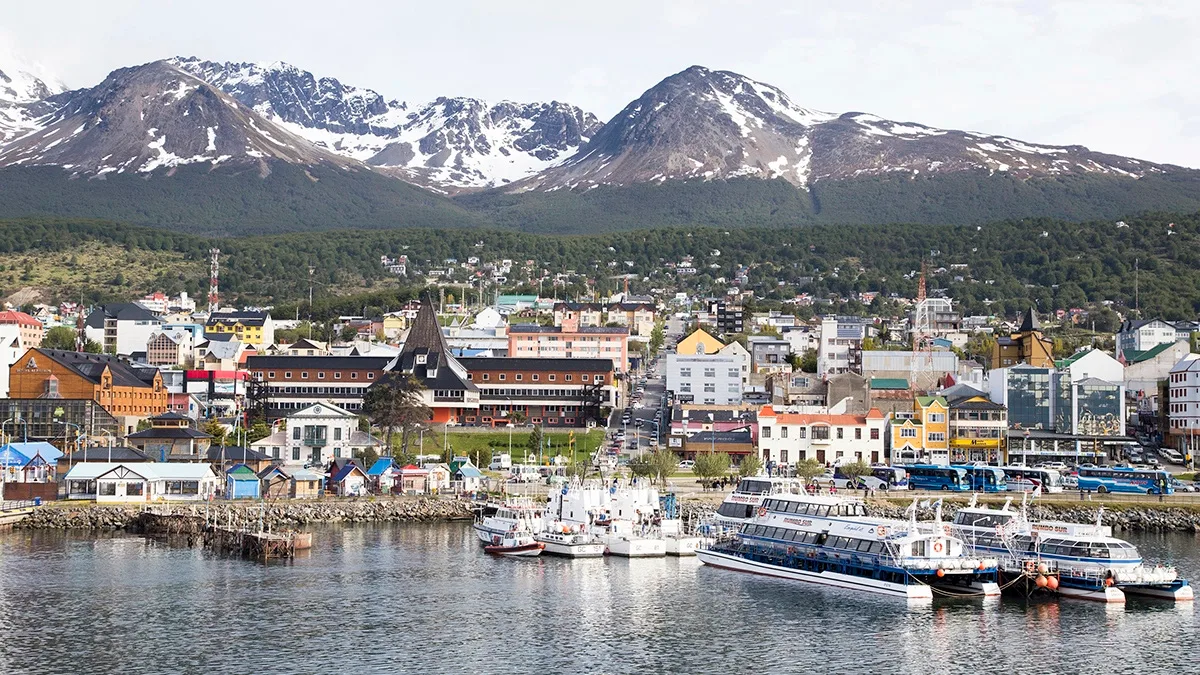
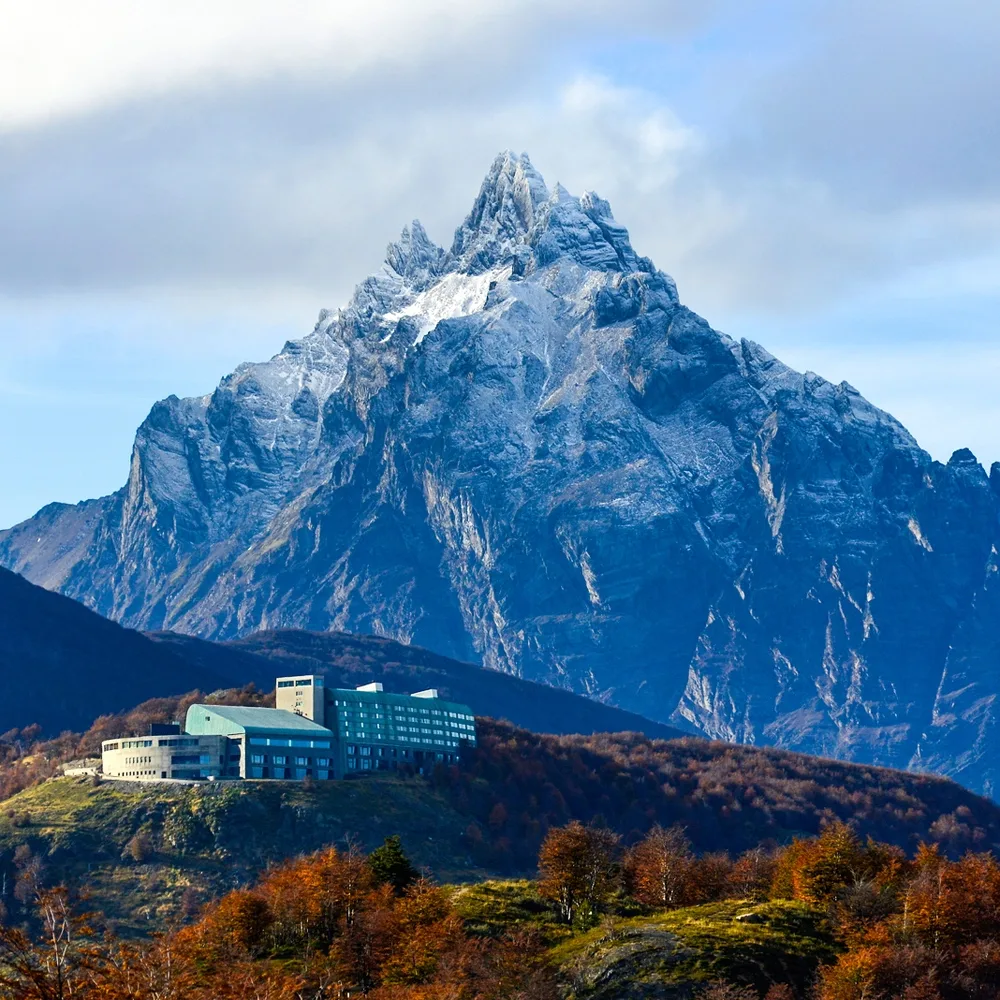
This bustling port is the capital of Argentina’s Tierra del Fuego Province. Set against the magnificent backdrop of the Martial Glacier, Ushuaia is a contender for the title of the world’s southernmost city.
After a briefing from your Expedition Team, you’ll have time to locate your cabin and explore the comforts and amenities on board.
Cross the Drake Passage
On the two-day crossing through the Drake Passage, the Expedition Team will equip you with everything you need to make the most of your polar expedition.
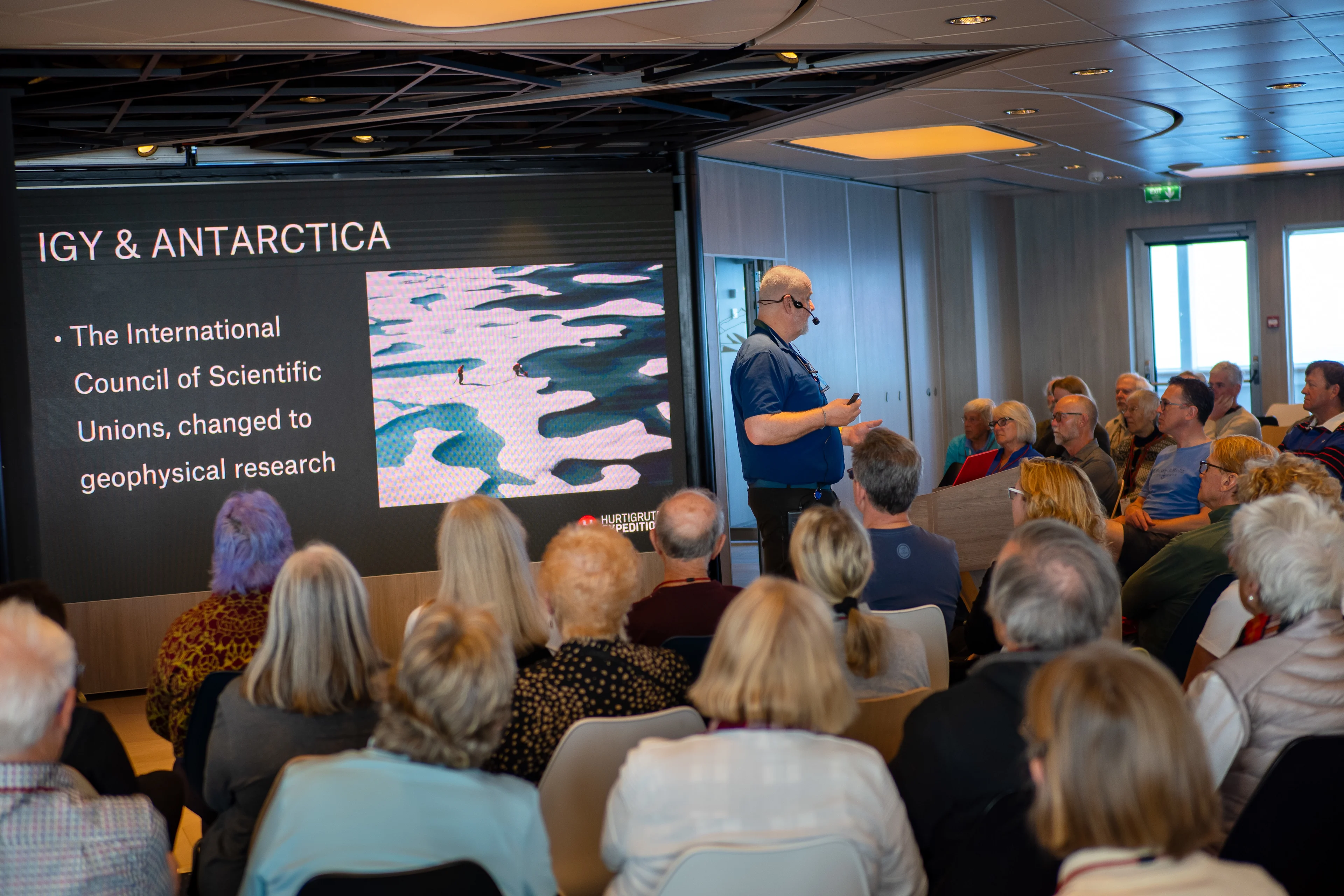
Visit the onboard Science Center and find out what lies ahead. Listen as experts talk passionately about Antarctica’s history, the science beneath the ice, and the impact of climate change and plastic pollution. Learn how to make your visit as safe and as low-impact as possible and discover the Citizen Science projects you can join.
There’s plenty of time to relax, so unwind in the spa and wellness area, enjoy delicious cuisine, and meet fellow travelers in the Explorer Lounge & Bar.

Experience Antarctica in all its natural majesty
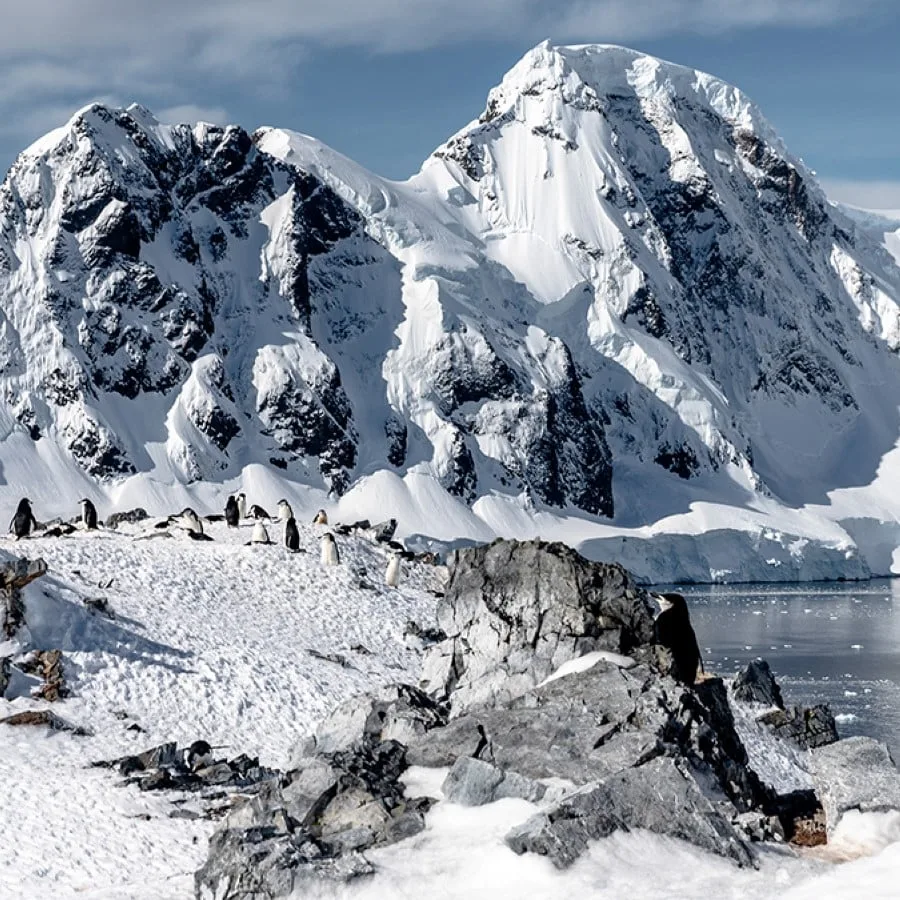
Nothing prepares you for your first sight of Antarctica’s immense, frozen beauty. Antarctica will fill you with wonder, surrounded by looming glaciers and icebergs the size of floating cathedrals. Perhaps the most surprising part of Antarctica is the silence. The stillness that reigns is broken every so often by the locals – the wildlife.
Whales begin to arrive in greater numbers by December and January. This is also when the first penguin chicks hatch. Seeing those clumsy clumps of feathers running around is always a charming sight. February and March are peak whale watching months, when huge amounts of krill lure whales to the area.
Nature is king here and we are mere observers. Our experienced Captain will continually monitor conditions to create the best possible itinerary for your adventure. Rest assured that each day will offer something different and thrilling.
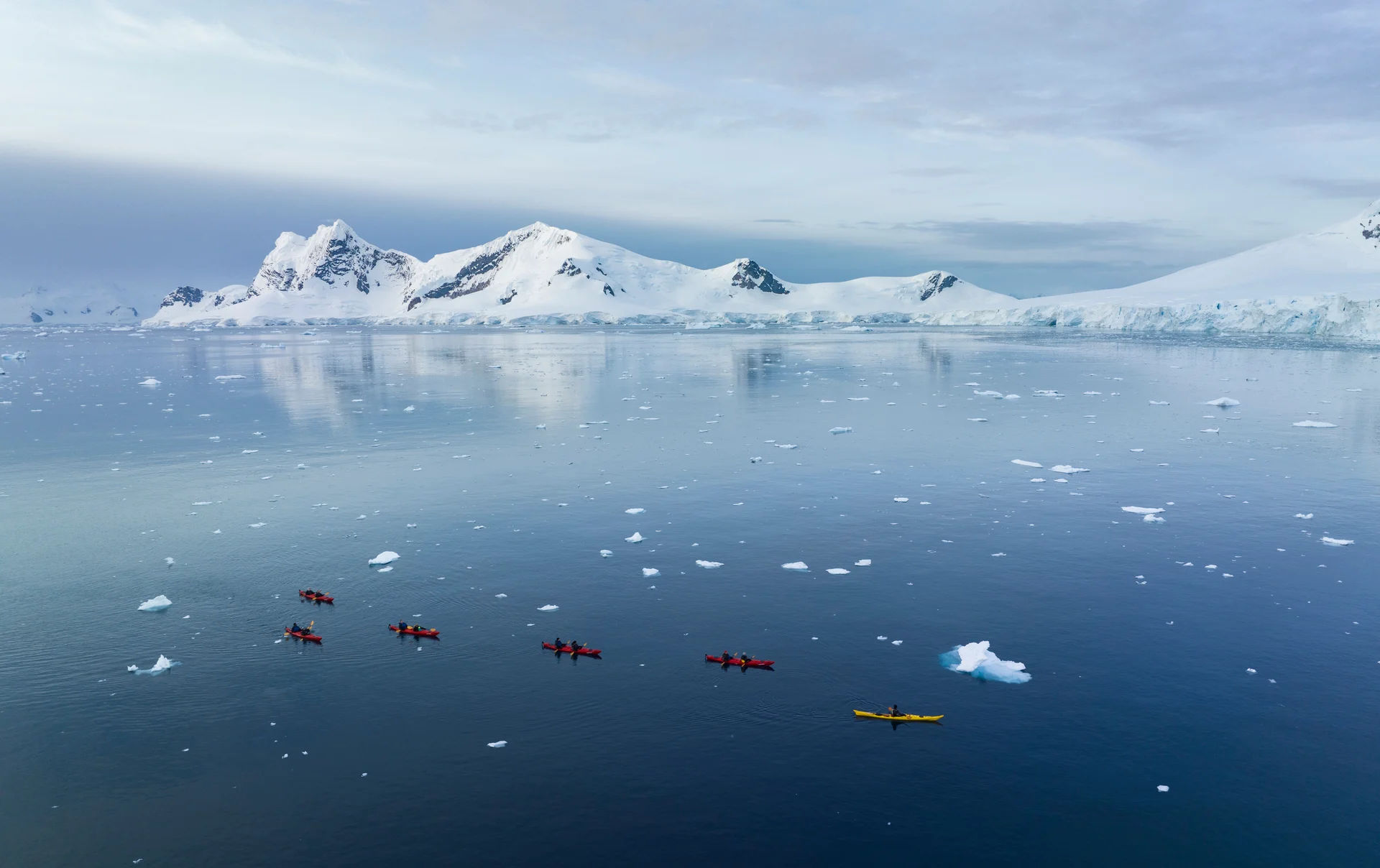
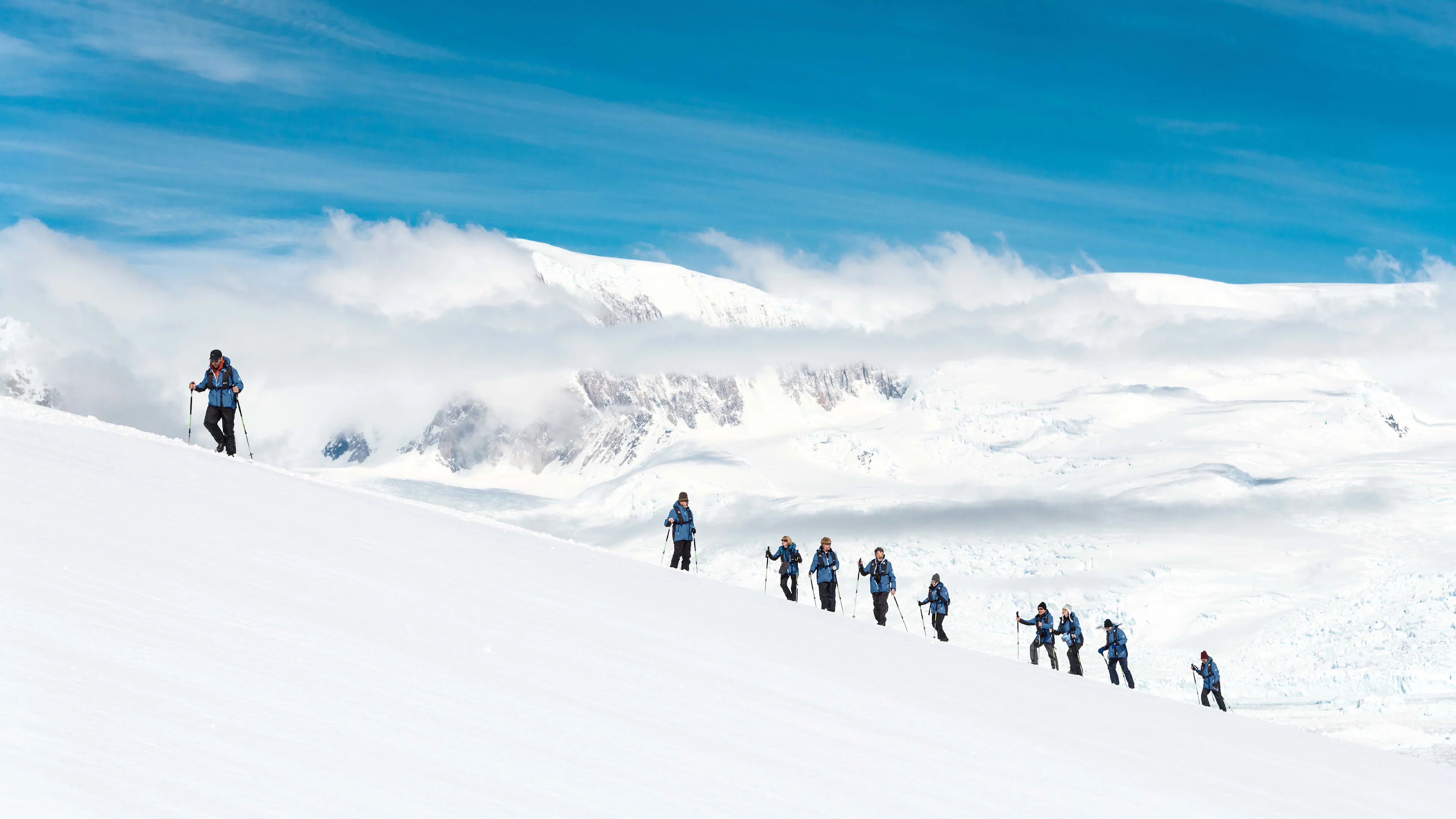
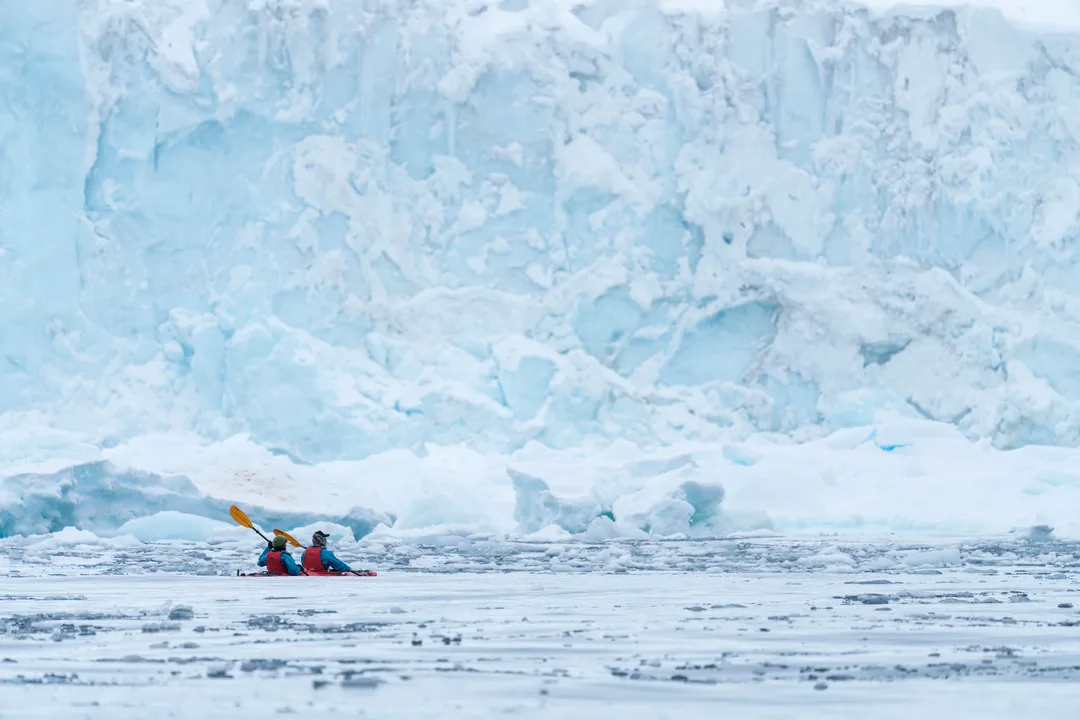
Join the Expedition Team on landings and while ice cruising. You may even have the chance to kayak among the icebergs.
Back on board, the Expedition Team will continue their lectures, helping expand your insight into the frozen continent. Over five magical days, experience this amazing world in a way that will stay with you for a lifetime.


Heading back north across the Drake Passage
After five incredible days, you’ll have experienced so much in Antarctica. Your head will likely be filled with a swirling kaleidoscope of special memories and impressions. The next couple of days will be a chance to reflect on your adventure to the seventh continent.
As your mind tries to conjure up the magical Antarctic scenery, now could be a good time to sift through your photos and videos to recapture a sense of its magnitude. Why not take the chance to unwind in the sauna, or enjoy a few relaxing spa treatments in the wellness area.
From Ushuaia to Buenos Aires
Your expedition cruise ends in Ushuaia, the main city in Tierra del Fuego, Argentina’s southernmost province. From here, you’ll take a flight back to Buenos Aires, but it doesn’t have to be the end of your adventure.
Why not join our optional Post-Programme before heading home.
Included activities & excursions
These activities are included with your trip. Dates and times will be confirmed closer to departure, you’ll just need to reserve your spot after booking.
What else is included?
Optional extras
Enhance your journey with optional extras. Some activities are only bookable onboard and can’t be reserved online or by phone. Subject to availability.

Our Antarctica ships
Get a taste of what life is like on board the ships that sail on this itinerary
Offers
Enjoy limited-time savings on selected sailings. Combinable on select offers.

Frequently Asked Questions
Why do I need to complete a Medical Screening Form?
At HX Expeditions - we explore some of the world's most remote locations and as such, in many of these locations, sophisticated medical services are few and far between. Medical care at sea is limited, and often emergency sea and air services may also be inaccessible, particularly in the polar regions. It is therefore vital that you make us aware of any current or past health issues, and as such we require a Medical Screening Form to be completed for Expeditions to Antarctica.
The Health, Safety and well-being of you our guests and our on-board crew are our top priority, and we want to ensure that all our guests are fit for travel. On board all our ships, we will have a qualified physician, which have a small, limited medical facility with basic medical supplies and equipment. Still, that makes it more difficult to diagnose and treat even the simplest conditions. This often leads to missed diagnoses, worsening conditions, a greater burden of chronic disease, and in some cases, unnecessary costly medical disembarkations.
How do I complete the Medical Screening Form?
We require all guests (including children) to submit and complete the Medical Form prior to departure to Antarctica.
Complete the form online through the Vikand Medical portal. It includes sections for both you and your doctor to fill out. You can begin the process up to 120 days before your sailing start date. Group bookings: access opens 90 days before your sailing start date. To start, Vikand will verify your name against our passenger list. If your name isn’t found, please contact HX or your local travel agent(if you booked through one) to ensure your name has been added to the booking exactly as it appears on your passport. For Doctor’s section - if your doctor can't sign the form, please consult an alternative or use Vikand’s online doctor service.
To make sure you receive important updates about your Medical Screening Form, we’ll send a verification email to the address you provided. Please check your inbox (and Spam/Junk folders) and click the verification link to continue. Once verified, you can complete the Guest Section of the form. If you don’t receive the email, try using an alternative address for future updates.
Please note: We only accept the Medical Screening Form available through Vikand portal and has been specially designed for HX sailings to remote destinations.
What’s included for suite guests?
A suite with HX is a premium, all-inclusive experience designed to elevate your expedition cruise. Suite guests enjoy priority boarding, access to the Lindstrøm fine-dining restaurant, premium drinks, laundry, welcome champagne, and much more. It’s the perfect way to indulge your inner explorer.
What does Antarctica look like?
Antarctica looks like little else on Earth! It’s a stunning icescape of whites and blues that tower up out of the sea in all sorts of wonderful shapes. There are high, snow-covered mountains where the wind sweeps the steep dark rock clean of any snow that doesn’t stick in the cracks. There are some rocky promontories too, however most of the land is covered in snow and ice with occasional rocks breaking through. With very little vegetation, Antarctica is vast and barren, however the warmer Antarctic Peninsula has some low vegetation in the summer.
From the sea, huge cliffs made of ice look like extra-bright and extra-white chalk cliffs. These vast ice shelves ‘calve’ enormous icebergs of diverse sizes and shapes, each one a unique sight to behold. Around the continent, the sea freezes in winter and then thaws in summer, leaving a patchwork of floating, broken ice with channels of green-black water between them. Even the more open water is often dotted with small floating lumps of ice when you come here on a Hurtigruten Expeditions’ cruise.
Where is Antarctica?
The southernmost continent in the world, Antarctica is located at and around the South Pole and is surrounded by the Southern Ocean. Almost all of Antarctica lies south of the Antarctic Circle in the Southern Hemisphere, which means temperatures are consistently below zero throughout most of the year.
Antarctica is 1672 miles from Australia when measured between Hobart and the nearest research base, the French Dumont d'Urville Station.
The nearest neighbouring continent to Antarctica is South America, where the closest part is shared by Chile and Argentina. Part of Antarctica – called the Antarctic Peninsula – extends north beyond the Antarctic Circle. From here it’s about 600 miles to the southernmost tip of South America, Tierra del Fuego.
Apart from South America, Antarctica’s other neighbours are the Falkland Islands, South Georgia and the South Sandwich Islands, Australia, and New Zealand’s South Island (Te Waipounamu).
Antarctica is sometimes confused with the Arctic, which surrounds the opposite pole of the Earth, the North Pole.
How to get to Antarctica?
To travel to Antarctica, the closest place to depart from is the southern tip of South America, from where you can take a ship or plane.
Most flights go from Punta Arenas in Chile to King George Island in Antarctica, which takes two hours. From King George Island, you then need to take a ship to reach the Antarctic continent or other islands. There are also limited flights to the interior of the continent, where you land on a runway of blue ice!
Alternatively, you can fly to Antarctica from Cape Town, South Africa, or sail from Australia, from South Island, New Zealand, or from Ushuaia, Argentina.
On a Hurtigruten Expeditions trip to Antarctica, you can cruise in comfort on one of our state-of-the-art ships that are outfitted for the purpose of making your trip as enjoyable and rewarding as possible. We offer expedition cruises with a variety of different itineraries so you can find the one that suits you best.
How to choose an Antarctic cruise?
We recommend choosing an Antarctic cruise provided by a reputable company with modern ships and top experts to help you understand and get the most from your incredible opportunity. Coming to such a pristine wilderness, we also consider it of the utmost importance to take care to protect the environment and keep it unspoiled.
At Hurtigruten Expeditions, we offer expedition cruises to Antarctica with a variety of different itineraries, so you can find one that suits you best. Simply get in touch with our knowledgeable experts – they’re always happy to help. They can talk to you and ask you about your preferences to help you choose your dream trip to Antarctica.
Once you’ve chosen a cruise, our friendly teams can give you expert advice on topics such as what you need to pack for Antarctica.
What animals live in Antarctica?
Antarctica is teeming with animal life. Even though it’s one of the least hospitable places in the world, the wildlife there is spectacular.
The largest animals of all are found around Antarctica – whales. The whales found here include blue, humpback, Minke, sperm, and beaked. It’s also thought that Antarctica has the largest population of orcas (a type of dolphin) to be found anywhere in the world. In addition, many other types of dolphins are found here. Seals abound, including fur seals, leopard seals, elephant seals and sea lions.
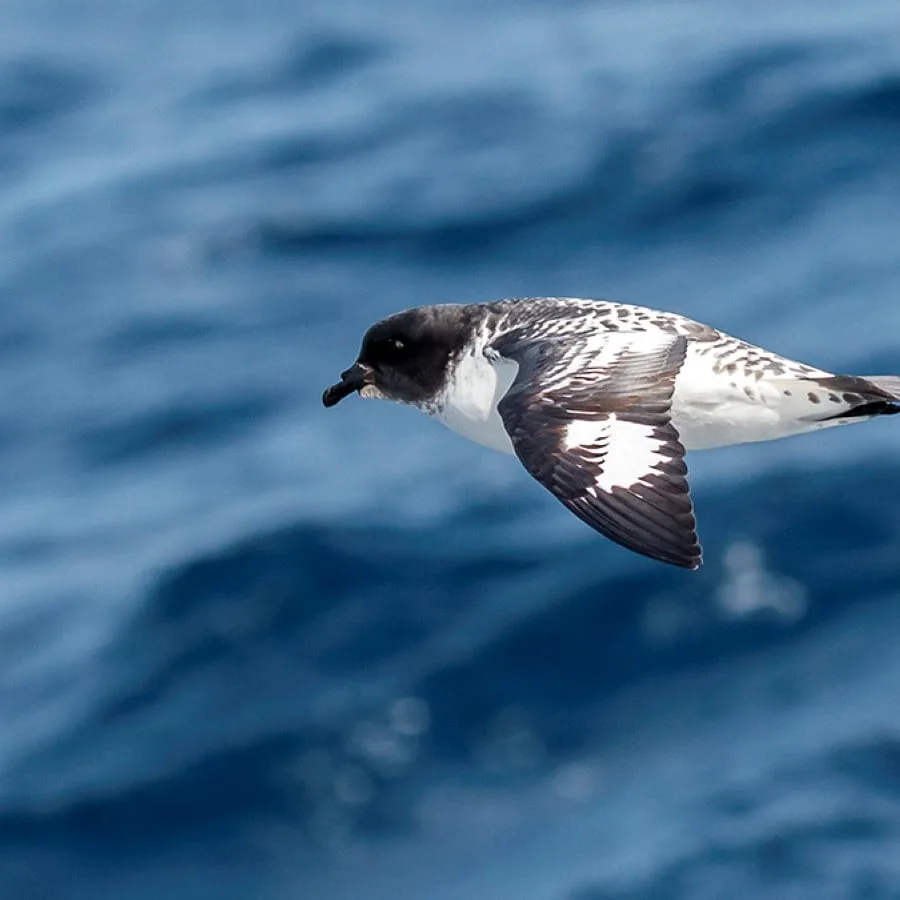
Penguins are the most common birds in the Antarctic, where there are about 20 million breeding pairs (40 million birds). There are 18 different species of penguins in Antarctica, and while most are migratory, the Emperor Penguin and Adélie Penguin remain on the continent year-round, hatching their eggs among the bare rocks. Other birds found here include albatrosses, petrels, skua, prions, fulmars, shearwaters, gulls, terns and cormorants.
Some of the most notable differences between Antarctica and the Arctic are the differences between the animals found there. While penguins are emblematic of the Antarctic, there are no penguins in the Arctic. Moreover, there are no land mammals, reptiles or amphibians in Antarctica, so there are no Polar Bears! In fact, the only terrestrial vertebrates in Antarctica are birds that are found on the sub-Antarctic islands – the South Georgia pipit and freshwater ducks.
Further down the food chain are huge numbers of krill, fish and squid that nourish the marine ecosystem. In fact, the vertebrates living in Antarctica are almost entirely dependent on the Southern Ocean surrounding the continent for sustenance.
Invertebrates in Antarctica include earthworms and molluscs, as well as spiders, beetles and flies – though these are mainly confined to the warmer sub-Antarctic islands. There are no flying insects on the Antarctic continent itself – only tiny nematodes and the Antarctic springtail arthropod are able to survive and complete their lifecycles there.
Do people live in Antarctica?
Yes, they do, but there are no people living permanently in Antarctica.
In Antarctica, there are many permanent research facilities, and some of them are constantly occupied. However, the individual people in these facilities typically stay for the summer before returning to their home country. While some people stay on through the winter and into the next summer, and sometimes through two or even three winters in a row, no one lives in Antarctica permanently.
During the short summer period, the population of researchers staying in Antarctica typically numbers around 4,000 people – a number that falls to around 1,000 during the winter.
The largest scientific base in Antarctica is McMurdo Station, which has about 1,000 people staying there during the summer. This number falls to about 200 during the winter.
Interestingly, women have given birth to babies at some of the scientific bases in Antarctica. At least 11 children are known to have been born there, to Argentinian and Chilean parents. However, they became citizens of their respective countries rather than of Antarctica and left soon afterwards, because Antarctica is not a country.
Who owns Antarctica?
No single country owns Antarctica, and there are no native inhabitants.
Many different countries have historically claimed certain areas of Antarctica as their territory. These are Norway, Australia, Argentina, the United Kingdom, France, New Zealand and Chile. However, these claims have never been universally recognised.
The Australian Antarctic Territory (AAT) is over 2 million square miles, which is nearly 80% the size of Australia. The AAT covers about 42% of Antarctica.
A unique international partnership – the Antarctic Treaty – has existed since 1959 to protect it. This sets aside any disputes over territorial sovereignty and binds the signatories to keep Antarctica as “a natural reserve, devoted to peace and science.”
Under the agreement of the Antarctic Treaty, the countries that are active in Antarctica consult each other on the uses of the continent, guarantee each other the freedom to perform scientific research, and prohibit the establishment of mineral mining, military bases, nuclear explosions and nuclear waste disposal. Consequently, there has never been war in Antarctica, and there are strong environmental protections in place.
Many countries have built research facilities in Antarctica in order to study the unique environment. In addition to the countries mentioned above, these include Russia, Ukraine, Pakistan, India, Italy and the USA.
No one lives permanently in Antarctica, and while there are some people in the buildings and research stations of Antarctica year-round, individual people stay for a limited time and then return to their own countries.
How cold is Antarctica?
It gets very cold. In fact, Antarctica is the coldest continent on Earth. The lowest temperature ever recorded at the surface of the Earth was recorded at Vostok research station, where the temperature once fell to −89.2 °C during winter.
However, the temperature varies considerably with the location, weather and seasons in Antarctica.
The coldest parts of Antarctica are in the interior of the continent, away from the coasts. Even during the summer, the interior remains below freezing with an average temperature of between −20 °C and −35 °C. The average temperature here during the coldest months is between −40 °C and −70 °C. It gets so cold because the sun doesn’t rise here in winter. Ever in summer, the sun remains low in the sky, so its rays are spread out over a wider surface area than they are in warmer parts of the world.
The warmest parts of Antarctica are the coastal areas, where the maritime climate keeps temperatures slightly higher. The average temperature during the coldest months here varies from −20 °C to −30 °C, while the mid-summer average temperature is about 0 °C on the coast.
The Antarctic Peninsula and the islands around it extend the furthest northwards towards the equator. Here, midsummer temperatures remain mostly below 0 °C, but can reach as high as 15 °C on occasion.
Research indicates the rate of climate change in Antarctica is greater than the global average.
How big is Antarctica compared to Australia?
At 5.4 million square miles of land mass, Antarctica is roughly twice the size of Australia and about 1.3 times as large as Europe. Antarctica is the fifth largest continent in the world, with 11,164 miles of coastline, about 45 percent of which is fringed with ice shelves.
In addition, Antarctica almost doubles in size during the winter. This is because it’s 98 percent covered with an ice sheet, which extends out from the land as ice shelves that float on the water of the Southern Ocean. During the winter, these ice shelves become extended as the sea freezes on a vast scale. At its peak, around 12.4 million square miles of the surface of the sea around Antarctica is frozen into sea ice. Much of this frozen sea ice melts during the Antarctic summer, leaving only around 1.8 million square miles of the sea frozen.
On land, the Antarctic ice sheet holds over seven million cubic miles of ice. If all the ice melted, global sea levels would rise by about 60 metres.
Antarctica is a high continent too, with significant mountain ranges. The highest mountain is Vinson Massif in the Ellsworth Mountains, which reaches up over 16,000 ft. Some of Antarctica’s mountains are entirely buried beneath the continental ice sheet.
Are there Polar Bears in Antarctica?
No, polar bears don’t live in Antarctica. In fact, there are no land mammals living there.
Polar bears are found in the Arctic, which is located around the northernmost region of the planet, and while they do move south of the Arctic Circle, they remain in the colder northern latitudes.
Interestingly, the name ‘Arctic’ comes from the Greek word for bear. This is because the constellation Ursa Major – also known as the Great Bear – is always visible there. The name ‘Antarctic’ means ‘opposite to the Arctic’.
If you’re interested in spotting polar bears, you might like to see our expedition cruises to Arctic destinations such as Svalbard.
Is Antarctica a desert?
Yes, much of Antarctica is a ‘cold desert’ or ‘polar desert’. This is because it is a large and extremely barren area where little precipitation occurs. In fact, as well as being the world’s coldest continent, it’s also the world’s driest.
Despite being a place with an abundance of ice covering the ground and sea, the interior of the Antarctic continent only gets an annual snowfall of a few inches. What’s more, the constantly low temperature in the interior keeps water frozen, making it very difficult for most forms of life to access it.
The coastal areas of Antarctica receive higher levels of precipitation and higher temperatures than the harsher interior of the continent. On the coast, temperatures can even rise high enough that precipitation falls as rain, while snowfall is typically measured in feet.
Plant life is only to be found along the coastal areas and islands where temperatures can rise above freezing. However, these plants don’t support any mammals, reptiles or amphibians. Most of the wildlife found in Antarctica such as penguins and seals depend on the ecosystems of the Southern Ocean for sustenance. The only terrestrial vertebrates are birds that inhabit the sub-Antarctic islands – the South Georgia pipit and freshwater ducks.
How does IAATO protect Antarctica?
IAATO (The International Association of Antarctica Tour Operators) protects Antarctica by advocating and promoting safe and environmentally responsible private sector travel to Antarctica that has no more than a minor or transitory impact on the Antarctic environment.
IAATO does this by providing a forum for more than 100 travel companies in the travel industry to cooperate and share their expertise, opinions, and best practices.
You can read more about the work of IAATO here.

